Qasr al-Khald: The Origin and Continuum of an Artist’s Memory
In the district of Dahra, where the spatial fabric of the city unfolds in close proximity to both history and domestic life, stands a structure whose presence exceeds its architecture. Known today under multiple names, each carrying its own historical and ideological weight, the palace remains one of the most quietly complex sites in Tripoli.
For Maysoon Ben Naji, a Libyan contemporary visual artist born and raised within this very district, the palace was never encountered as an isolated landmark. It existed within the radius of lived experience—approximately one and a half kilometres from her family home, a distance that collapses easily in practice: a brief walk, a short drive, an almost habitual crossing. Yet what this distance enabled was not familiarity alone, but repetition—and through repetition, a deeper, less visible form of perception.
The building’s origins date back to the Italian colonial period, when architecture was mobilised as an extension of governance. Its symmetrical façade, measured proportions, and controlled geometries articulate a language of authority—one in which space is ordered, directed, and ultimately observed. The palace was not intended to host ambiguity. It was designed to eliminate it.
With the establishment of the Libyan state under King Idris I, the building entered a new symbolic phase. It became associated with monarchy and governance, widely recognised as Qasr al-Malik — the King’s Palace. Within this framework, the site retained its architectural authority, but its meaning shifted toward sovereignty, statehood, and the ceremonial articulation of a newly independent nation.
Names, in this context, do not merely describe—they position. They reflect shifts in authority, ideology, and collective consciousness.
Following the political transformation of 1969, the association with monarchy was deliberately removed. The palace was renamed Qasr al-Sha‘b — the People’s Palace, marking a decisive ideological shift. The term “king” was replaced with “people,” reorienting the building within a new narrative of public ownership and national identity.
This change was neither superficial nor incidental. It represented a broader redefinition of power—one that sought to dissolve hierarchical symbolism and replace it with collective rhetoric.
In subsequent years, another name emerged: Qasr al-Khald — the Palace of Eternity. Here, the language moved further into abstraction. Neither king nor people were invoked directly. Instead, the emphasis shifted toward permanence—an attempt to position the site beyond immediate political frameworks.
And yet, names do not disappear as easily as they are assigned. In contemporary usage, the name Qasr al-Malik has resurfaced organically, coexisting with its later designations. It persists in speech, in memory, and in the informal language of those who have lived in proximity to the site.
The palace, therefore, is not defined by a single name. It exists within the tension between them.
In the early 2000s, the palace entered a quiet yet decisive phase. It was neither a formal cultural institution nor an abandoned site. It became something else entirely.
On summer evenings, as the intensity of the day receded, the space began to shift. Light softened. Air grew still. And sound began to take form—not as performance, but as presence.
Ma’louf, muwashshahat, and devotional recitation unfolded not as structured events, but as lived states. Voices extended into space, moving through the trees, returning from architectural surfaces, and settling almost imperceptibly into memory.
In such moments, sound did not occupy the space. It defined it.
Within a site constructed to assert control, a different condition emerged—one in which control dissolved into presence, and presence into shared experience. There was no fixed audience, no centralised point of attention, and no singular interpretation to be secured.
Meaning was not delivered. It was encountered.
For the young Maysoon, moving through this environment alongside her family, there was no conceptual framework through which to interpret what was taking place. There were no formal distinctions between music, devotion, and atmosphere. Yet what was absent in terminology was retained in another form.
What is not fully understood is often more deeply absorbed. The child does not analyse; she registers. Rhythm becomes internalised as breath. Sound is not external—it reorganises perception from within. Even silence acquires weight, structuring the intervals through which experience is processed.
These impressions do not return as narrative memory. They re-emerge as orientation.
As Ben Naji later expressed, “Sound was never something I heard. It was something that arranged me.”
This early exposure evolved into sustained engagement. Beginning in 2004, through her involvement in the Libyan scouting movement, and continuing for many years, the palace became a recurring site of presence—hosting cultural activities, gatherings, and communal events.
Yet despite these structured contexts, the essential nature of the space remained unchanged. The palace did not impose behaviour. It absorbed it.
Repeated presence dissolved the boundary between site and self. The location ceased to be external; it became embedded within the artist’s perceptual framework.
This is what may be understood as a core memory—not a recollection that can be narrated, but a structure that persists.
“I do not paint what I saw. I paint what remained,” Ben Naji concluded.
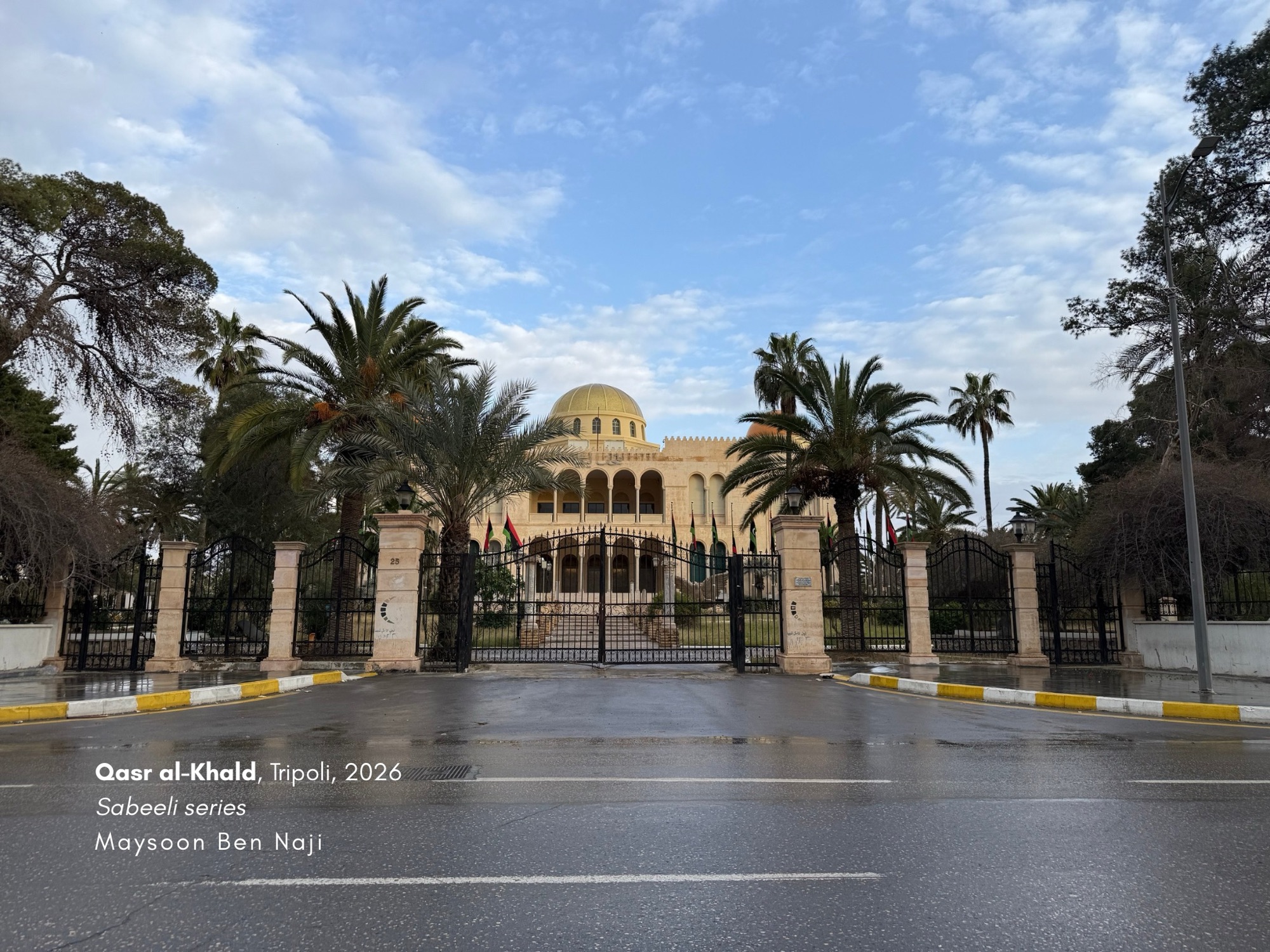
On the first day of Eid al-Fitr in 2026, the artist returned to the palace with a fully formed awareness of its significance. No longer a passive witness, she approached the site through the lens—both literally and conceptually.
The photograph produced on that day is marked by restraint. The palace stands centred, framed by palm trees, its gates closed yet visually permeable. The ground, darkened by rainfall, reflects both structure and sky, creating a subtle doubling.
Rain here is not incidental. It activates the surface, deepens tonal variation, and introduces reflection—not as distortion, but as quiet extension.
Tripoli, in that moment, appears luminous without spectacle—composed, present, and layered with memory.
The image does not attempt to define the place. It allows it to remain.
“The work does not begin on the canvas. It begins where memory refuses to fade,” Ben Naji observed.
What, then, does the palace represent?
Not solely a historical structure, though its past is evident. Not merely a personal memory, though its imprint is profound. It is a site where temporalities coexist—colonial, monarchical, revolutionary, and personal—without resolution.
Its names shift. Its meanings evolve. Yet something remains.
For the viewer, the palace offers no singular narrative. It proposes instead a mode of attention—one that resists immediate classification.
To look without naming. To perceive without resolving.
To recognise that certain places do not remain as images, but as ways of seeing.
In this sense, the work of Maysoon Ben Naji does not emerge from the palace as subject. It emerges from it as condition.
And in that condition, the palace continues—not as it was, but as it persists.
© 2026 Maysoon Ben Naji. All rights reserved.