Abstract Art and the Sufi Vision

In the contemporary landscape of visual arts, abstract painting occupies a unique space that bridges the tangible and the ineffable. It is a medium where color, form, and texture transcend representational constraints, allowing the artist and the viewer to engage in an intimate dialogue of perception and emotion. From my vantage point as a practicing visual artist, abstract art is not merely an aesthetic exercise but a vessel for spiritual exploration, deeply intertwined with the principles and sensibilities of Sufism.

Sufism, the mystical dimension of Islam, emphasizes the direct experience of the divine through introspection, meditation, and the dissolution of the ego. Central to its philosophy is the belief that the material world is but a reflection of higher realities; hence, true understanding is accessed through internal contemplation rather than external observation alone. In this context, abstract art resonates profoundly with Sufi thought, as it embodies the capacity to convey the unseen through visual means, to translate subtle spiritual vibrations into form, and to invite the viewer into a space of quiet introspection.

The Language Of Abstraction

Abstract art is often described as a “language without words,” a form of expression that communicates through nuance, rhythm, and visual resonance rather than explicit narrative. Shapes, lines, and colors function as carriers of meaning, yet their significance is not fixed; it evolves in dialogue with the observer’s perception. This fluidity mirrors Sufi practice, in which truth is not codified in rigid doctrine but emerges in the relational space between seeker and experience.

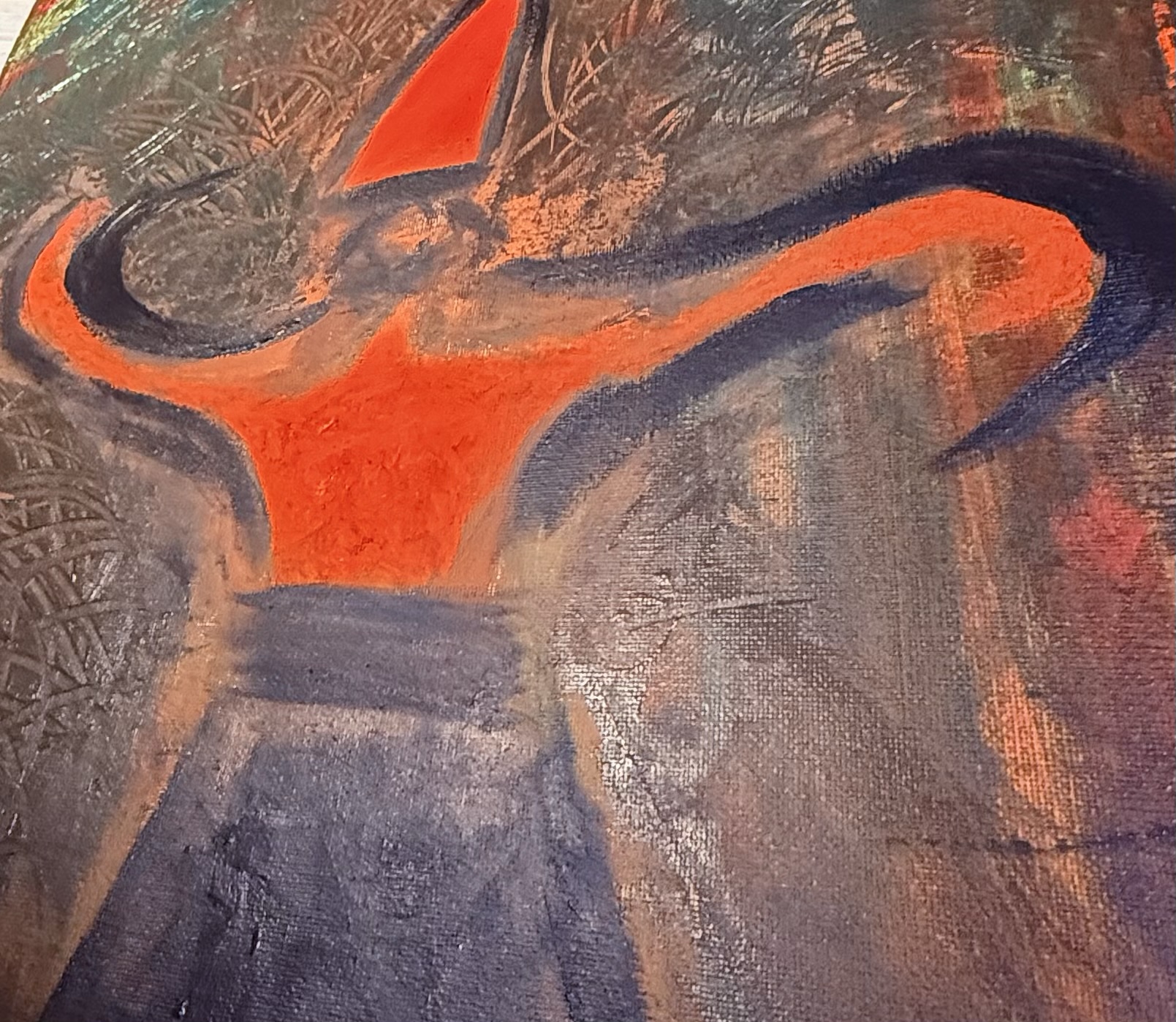
In my own engagement with abstraction, I have observed that certain visual motifs—repeated arcs, spiraling lines, pulsating textures—evoke the subtle energies described in Sufi cosmology. These are not literal depictions of spiritual concepts but intuitive representations, gestures that translate inner experience into external form. Just as a Sufi dervish whirls to dissolve the boundaries of self, the abstract composition dissolves conventional spatial hierarchies, allowing movement, rhythm, and balance to convey a deeper order.

Memory And Intuition As Creative Catalysts

The creative process in abstract art is inseparable from the artist’s inner life. Memories, intuitions, and ephemeral feelings converge on the canvas, often spontaneously, echoing Sufi emphasis on presence and attentiveness. Every stroke is an act of meditation: a conscious yet fluid interaction with the material, a negotiation between control and surrender. In this sense, the canvas becomes a mirror of the soul’s journey, a locus where the transient and eternal intersect.

Sufism teaches that the heart is the locus of divine knowledge, a subtle organ attuned to vibrations beyond ordinary perception. Similarly, abstract art relies on sensitivity and receptivity, on the capacity to translate intangible impulses into visual form. This is not a mechanical process but a relational one: the artist listens, responds, and collaborates with the materials, allowing form to emerge organically. Through this approach, abstraction becomes a means of witnessing, an encounter between the internal landscape of consciousness and the external reality of the medium.

Color As Spiritual Resonance

Color in abstract art functions far beyond its decorative role. It is a carrier of emotion, a conduit of spiritual vibration. In Sufi practice, sensory experiences are often employed as tools for cultivating awareness and tuning the heart toward higher states. Similarly, the artist’s engagement with color can evoke resonance within the viewer, eliciting contemplative states that transcend ordinary perception.

Vibrant reds, luminous golds, and deep blues are not merely aesthetic choices; they are deliberate engagements with symbolic and energetic qualities. The way pigments interact on the canvas—the layering, transparency, and interplay of textures—creates a rhythm that mirrors the cycles of spiritual experience: emergence, dissolution, and renewal. In this sense, abstract composition is akin to a visual dhikr, a remembrance and repetition that invites reflection on the unseen order underlying apparent chaos.

Space, Void, And Infinite Possibility

One of the defining features of abstract art is its embrace of negative space and ambiguity. Empty areas are not voids in the conventional sense; they are active presences, spaces of potential, inviting engagement and introspection. This concept aligns closely with Sufi metaphysics, which regards emptiness as a fertile ground for divine manifestation. The absence of form is as meaningful as the presence of color, creating a dynamic tension that animates the composition and opens a pathway for contemplative engagement.

The interplay between form and void in abstract painting mirrors the Sufi understanding of existence itself: a continuum between the manifest and the unmanifest, the known and the unknowable. The canvas becomes a microcosm of this spiritual paradigm, a domain where perception and imagination coalesce, and where the viewer is invited to participate in the unfolding of meaning.

Gesture, Rhythm, And Transcendence

Beyond color and space, gesture is a crucial element in abstract art, carrying both physical and metaphysical weight. Each movement of the hand, each application of pigment, embodies an energy that extends beyond the canvas, echoing the Sufi belief in the interconnectedness of all things. Rhythm—the repetition of shapes, the flow of lines, the cadence of brushwork—evokes spiritual states that are often described in mystical texts as oscillations of the soul, harmonics of consciousness attuned to the divine.

Abstract art, in this sense, is performative as well as visual. It is not merely about the final image but about the process itself: the dance between intention and intuition, control and surrender. This experiential dimension mirrors the Sufi path, where the journey toward enlightenment is as vital as the attainment of insight. The viewer, in engaging with the work, becomes a participant in this rhythm, attuning their perception to subtle currents of energy and meaning.

The Viewer’s Journey

While the artist initiates the exploration, the meaning of abstract art is never complete without the engagement of the viewer. Sufism emphasizes relational knowledge, where understanding is co-created in the encounter between seeker and reality. Similarly, abstract art thrives on the interpretive participation of those who behold it. Each observer brings their own memory, sensibility, and intuition, interacting with the forms and colors to produce unique, personal experiences.

This dynamic underscores a fundamental principle: abstract art is not didactic. It does not prescribe meaning but rather opens a space where reflection, contemplation, and imagination can flourish. The artwork functions as a mirror and a conduit, a medium through which the unseen can be intuited, even if only fleetingly. In this capacity, it embodies the Sufi aspiration to perceive the hidden within the visible, the infinite within the finite.

Conclusion: Art As Spiritual Praxis

From the perspective of a contemporary artist informed by Sufi sensibilities, abstract painting is more than an aesthetic pursuit. It is a form of spiritual praxis, a discipline of attention, intuition, and presence. Through abstraction, the artist negotiates the liminal space between materiality and spirit, translating subtle energies into tangible form. In turn, the viewer is invited into a participatory experience, one that cultivates reflection, empathy, and a heightened awareness of the interconnection between self, world, and the divine.

In an era dominated by visual saturation and rapid consumption, abstract art offers a rare opportunity for pause, contemplation, and encounter. It asserts that meaning is not imposed but discovered, that beauty is inseparable from insight, and that the journey of perception is itself a form of devotion. In bridging the sensibilities of abstraction with the spiritual ethos of Sufism, the artist and the observer alike are reminded that art is, ultimately, a vessel for the invisible—a conduit for the energies, memories, and subtle truths that shape our inner and outer worlds.