Introduction: The Threshold of Self-Naming
There is a profound, almost sacred silence that descends upon a room when a creator stands before a blank canvas, a block of unyielding stone, or a pristine sheet of paper. In that quiet intersection of breath and matter, a fundamental question echoes through the chambers of the human soul: When does one truly have the right to call oneself an artist?
To the uninitiated, the title of an “artist” is often conferred from the outside. It is mistakenly viewed as a credential granted by institutions, a diploma framed upon a gallery wall, or a commercial milestone. Yet, from a deeper philosophical and spiritual vantage point, waiting for the world to anoint you is a form of quiet spiritual exile. Art is not an external achievement added onto a human being like a garment; it is an intrinsic, ontological reality that breathes within the very marrow of your bones.
I. The Ontological Nature of Art: A Primordial Imprint
To understand when one becomes an artist, we must first redefine what art fundamentally is. Art is a primordial language of the spirit—a bridge thrown across the vast chasm between the finite human experience and the infinite expanse of the cosmos.
Long before you ever picked up a brush, mixed a pigment, or stretched a canvas, the artist existed within you as a pre-linguistic pulse. Every human being is born with a distinct, unrepeatable perspective on creation. We are all vessels of perception, filtering the raw, overwhelming chaos of the universe through our senses, sorrows, and raptures.
- The Internal Resonance: This is a quiet murmur that whispers that there is more to existence than what meets the physical eye.
- The Perceptive Lens: It is the inescapable urge to look at a bruised twilight sky or a weathered human face and feel an ache so profound it demands expression.
You do not choose this sensitivity; it chooses you. To be a visual artist is to possess a nervous system finely tuned to the frequencies of beauty and melancholy that hum beneath everyday life. Because this trait is embedded in your metaphysical DNA, the question is never how to acquire artistry, but rather when you will awaken to what has always resided within your spirit.
II. The Epiphany of Discovery and Sovereign Self-Nomination
Discovery is the first major milestone on the path. Most people treat their creative impulses as fleeting fancies or impractical hobbies. The true artist, however, reaches a pivotal crossroads where they can no longer ignore the fire burning in their chest.
This discovery arrives when you realize that when you create, time dissolves. The anxieties of the material world evaporate, and you enter a state of pure presence. Your creative output is simply the physical footprint left behind by your soul as it journeys through consciousness. Yet discovery alone remains incomplete if it stays locked away in private doubt.
Here lies the crucible of the artistic journey—the precise philosophical juncture where hesitation must yield to sovereignty. It is your absolute duty to name yourself an artist.
“Creation is not merely the making of objects; it is the unearthing of the soul’s buried architecture. To discover the artist within is to realize that your hands are instruments of a dialogue that transcends spoken words.”
Society operates on a transactional economy of validation, waiting for market viability or popular acclaim. But art is fundamentally antithetical to bureaucracy. If you wait for the world to validate your calling, you surrender your creative sovereignty. By naming yourself without waiting for permission, you honor the creative source that birthed you. You acknowledge that your visions are sacred responsibilities entrusted to your care.
III. The Mirror of the Collective
There is a fascinating spiritual law that governs human interaction: The world tends to treat you the way you treat yourself.
If you approach your art with timid apologetics—introducing your work with phrases like “Oh, I just dabble a bit”—the world will echo your hesitation. Conversely, when you step forward with quiet, unshakeable conviction grounded in spiritual alignment, the atmosphere shifts.
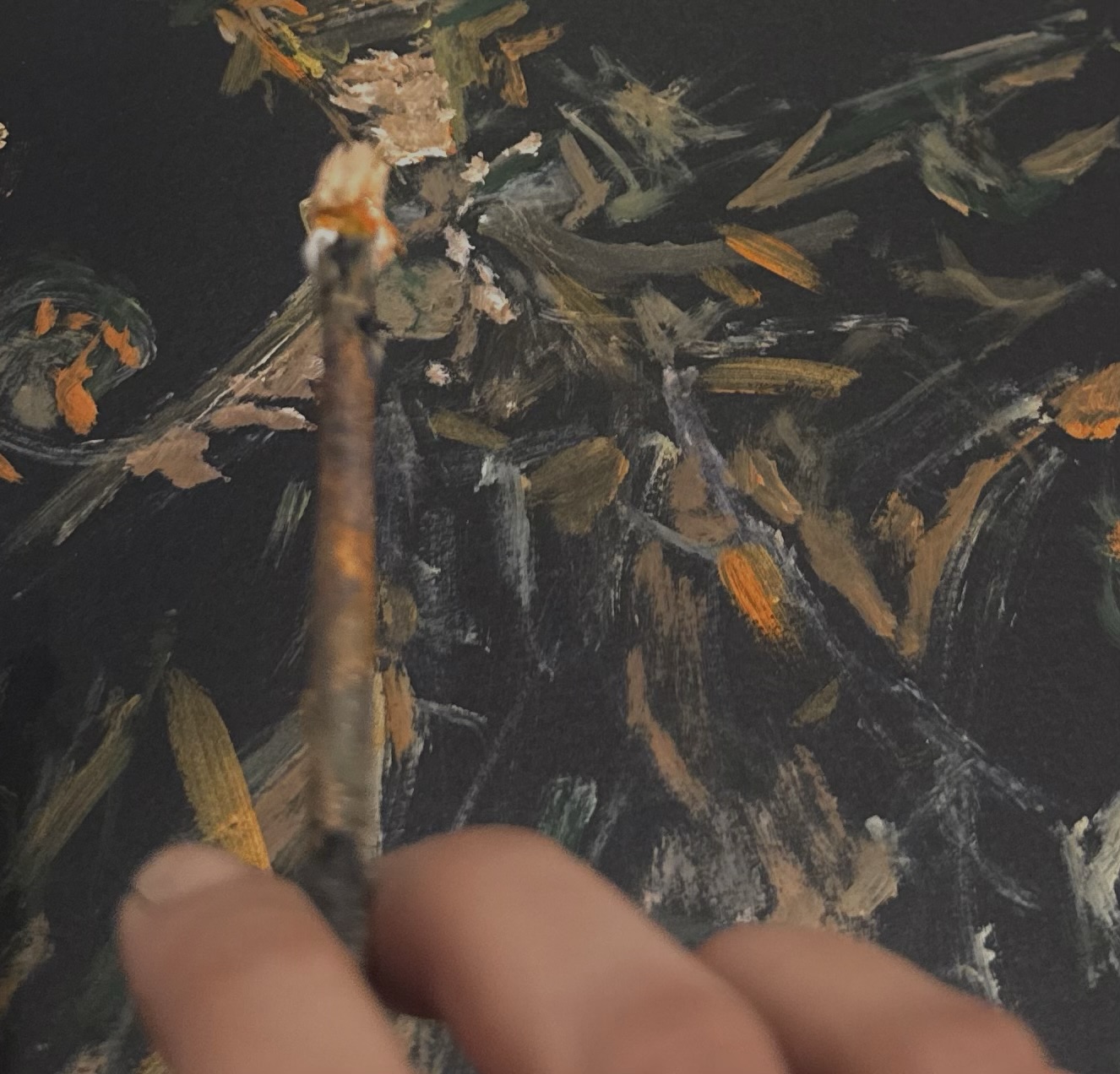
When you own your title, your posture changes. People begin to recognise you as an artist not because of a certificate, but because your entire energetic field projects the undeniable reality of one. They see the passion in your brushstrokes and bow to the truth you have already established within your own sanctuary.IV. Navigating the Shadows and the Spiritual Burden
To call oneself a visual artist is to enter into a covenant with both the visible and the invisible worlds. A well-composed painting or striking juxtaposition of light and shadow can pierce the human heart faster than a thousand reasoned arguments. You take the formless emotions of grief, ecstasy, and existential longing, and you force them into physical shapes. This is both a glorious ecstasy and a heavy spiritual burden requiring relentless honesty.
No honest exploration can ignore the shadows of self-doubt. The moment you claim the title, you invite the inner critic. Yet, these shadows are not signs of a mistake; they are the necessary friction that refines your spirit. Art is forged in solitude, and the struggle against the blank canvas is the mechanism through which spiritual evolution occurs. You are an artist because you keep returning to the easel to try again despite the struggle.Conclusion: The Final Brushstroke
When, therefore, does one truly call oneself a visual artist?
The answer is as simple as it is terrifying: Right now.
It happens the moment you drop the weight of external approval and recognise that the impulse to create is the signature of the divine within you. Do not wait for permission. Pick up your tools, step up to the surface of creation, and let your spirit speak its native tongue. Name yourself an artist with quiet, unshakeable grace—and watch as the world steps back, falls silent, and learns to recognise the magnificent truth you have already declared.